The primary difference between woven and knitted fabrics lies in how the yarn is constructed. Think of weaving as a “grid” and knitting as a “loop.”
1. Construction Method
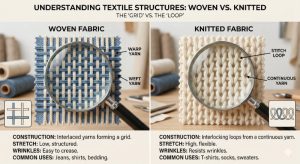
Woven: Two sets of yarn are interlaced at right angles. The horizontal yarns (weft) go over and under the vertical yarns (warp). This creates a very stable, grid-like structure.
Knitted: A single continuous yarn is looped through itself repeatedly (using needles or machines). Imagine a row of interconnected “V” shapes.
2. Stretch and Fit
Woven: Generally has little to no stretch unless elastic fibers like spandex are added. Because the structure is tight, woven garments hold their shape very well and are often tailored (e.g., button-down shirts, denim jeans).
Knitted: Inherently very stretchy because the loops can expand and contract. Knits conform to the body easily, making them perfect for activewear, t-shirts, and sweaters.
3. Durability and Wrinkling
Woven: More durable and resistant to pilling, but they wrinkle easily. If you fold a woven shirt, it will likely need an iron.
Knitted: Very wrinkle-resistant. You can crumple a t-shirt in a gym bag, and it will usually bounce back. However, knits are more prone to “snagging” or “running” (like a hole in a sweater) if a loop breaks.
How to tell them apart?
If you aren’t sure which one you’re holding, try the Stretch Test: Pull the fabric in all directions. If it stretches significantly, it’s likely a knit. If it resists and only moves slightly diagonally (the bias), it’s likely a woven.

The primary difference between woven and knitted fabrics lies in how the yarn is constructed. Think of weaving as a “grid” and knitting as a “loop.”
1. Construction Method
Woven: Two sets of yarn are interlaced at right angles. The horizontal yarns (weft) go over and under the vertical yarns (warp). This creates a very stable, grid-like structure.
Knitted: A single continuous yarn is looped through itself repeatedly (using needles or machines). Imagine a row of interconnected “V” shapes.
2. Stretch and Fit
Woven: Generally has little to no stretch unless elastic fibers like spandex are added. Because the structure is tight, woven garments hold their shape very well and are often tailored (e.g., button-down shirts, denim jeans).
Knitted: Inherently very stretchy because the loops can expand and contract. Knits conform to the body easily, making them perfect for activewear, t-shirts, and sweaters.
3. Durability and Wrinkling
Woven: More durable and resistant to pilling, but they wrinkle easily. If you fold a woven shirt, it will likely need an iron.
Knitted: Very wrinkle-resistant. You can crumple a t-shirt in a gym bag, and it will usually bounce back. However, knits are more prone to “snagging” or “running” (like a hole in a sweater) if a loop breaks.
How to tell them apart?
If you aren’t sure which one you’re holding, try the Stretch Test: Pull the fabric in all directions. If it stretches significantly, it’s likely a knit. If it resists and only moves slightly diagonally (the bias), it’s likely a woven.